A conference, meeting, symposium; each meeting has its own form and characteristics. And often they all have to do with knowledge sharing. But... what exactly is a conference? Why do you organise a conference and what elements make them successful? We tell you everything you need to know.
What is a conference?
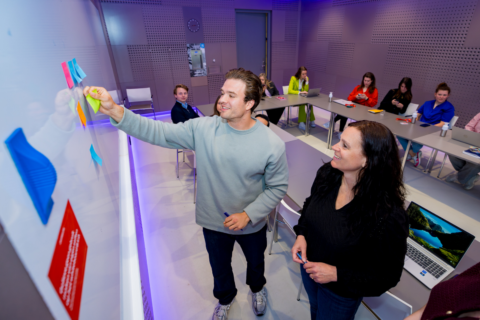
A conference is a gathering of people from the same sector, industry, field or with a shared interest. The purpose of a conference is to exchange ideas and make contacts. It is a place where people come together to gather more knowledge. To become smarter, in other words. The Van Dale defines a conference as a gathering of diplomats, politicians and businessmen. Also called: a deliberation. A conference usually has a topical theme. Think sustainability, climate, healthcare, education or innovation.
A conference can be small or large: from dozens of participants to as many as hundreds. What matters is that it is about deepening, connecting and renewing.
The benefits of a conference
A conference has several pluses. If you ask us, there are four very clear advantages, namely:
- Gaining new insights
This is one of the main reasons people attend a conference: here, they gain more in-depth information on a specific topic. Speakers from within (or indeed outside) the field come to talk about the theme. One thing is certain: participants return home enriched with new knowledge.
- Networking
Some professional fields and sectors are small, whilst others are vast. Either way, you can never connect with everyone. It’s great for participants to know that they can talk to like-minded people without having to make an appointment. Making contacts and networking is therefore a major benefit of a conference.
- Inspiring one another
Where people come together, wonderful things happen. We say this often, because it’s really true! It’s magical to see how collaborations take shape, or how new projects are launched – ‘born’, as it were – at a conference.
- Strengthening your reputation
If your company operates in a particular sector, you have a reputation to uphold. By organising a conference, you demonstrate that you are an expert in that field. It strengthens your reputation and improves your visibility within the sector.
How do you organise a conference?
Organising a conference is not something you do 'on the side'. It is a serious event that requires time and energy. If you do this well, you can achieve great results. We will help you on your way: keep these five tips in mind:
- Location is important.
Choose an event venue that is suitable for the type of conference. Consider the topic and the target audience carefully, and then select the venue. Where are the participants coming from, and what are the minimum requirements for the venue? For example: if you’re organising a conference on sustainability, don’t choose a venue that guzzles energy and causes pollution. Or one that can’t be reached by public transport.
- Choose a clear objective and theme
What is your aim for the conference? Do you want to build support? Bring people together? Share knowledge? Decide on the conference’s objective in advance and then choose a theme. A theme will in turn help you put together the programme.
- Select the right speakers
Sometimes one speaker is the absolute expert on the subject, whilst another might actually open your eyes. Take a good look at what a speaker can bring to the table. It’s precisely by doing something a bit unconventional that you’ll achieve great results. However, do also take a close look at well-known names, as that in itself can be the very reason why people want to attend your conference.
- Promote your conference
You’ve been organising your conference for weeks (or months) and you know all the details. But does your target audience know them too? Tell them what you’re working on, who you’re inviting, and what people can expect. Give them a sneak peek or ask your target audience for input. By actively involving them in your organisational process, you’ll build greater trust.
- Ensure everything runs smoothly
And then onthe day itself: how do you ensure everything goes off without a hitch? By drawing up a schedule. Here, you set out from A to Z what is expected, when and by whom. You can also share the schedule with the venue, so the experts there know what’s planned. Extra tip: include the phone numbers of key people in the schedule. That way, you can always refer back to your schedule – even if you don’t have your mobile to hand.
How long should a conference be?
A question we regularly get is about the length of a conference. It depends on the purpose, the target audience and, of course, the programme. So there is no standard answer. Fortunately, there are guidelines. Consider:
Half a day: ideal for a deep dive, or if you want to focus on a single topic
A full day: perfect for several keynote speeches, breakout sessions and a networking opportunity
Multi-day: highly suitable for larger (international) conferences, with a varied programme, a range of speakers and networking opportunities
Want to know more about organising an event? We're here for you. For tips, help and, of course, a great space. And what's more: at Jaarbeurs we have more than 100 years of experience in hosting and organising various conferences. We help you with all aspects so that you organise a successful conference.